Financial trading vs investing is not simply a difference in holding period. Investing focuses on deciding what assets deserve your capital, while trading focuses on how positions are executed, managed, and adjusted within the market. Understanding this distinction can change how you evaluate opportunities, risk, and performance.
I often notice that people use the words trading and investing as if they mean exactly the same thing. In practice, they are closely related but they solve different problems.
An investor may spend weeks deciding whether a security deserves a place in a portfolio. A trader may spend minutes, hours, or days deciding how to execute that decision efficiently. Both activities matter. Ignoring either one can lead to disappointing results.
The distinction becomes even more important as markets become faster, more complex, and more dependent on liquidity and execution quality.
Takeaways
- Investing focuses on selecting assets and allocating capital.
- Trading focuses on execution, timing, liquidity, costs, and risk management.
- Speculation, arbitrage, and hedging are three major motivations for trading.
- Buy-side participants seek liquidity, while sell-side participants often provide it.
- Strong investment decisions can still produce poor outcomes if trades are executed poorly.
What Is Investing and What Is Trading?
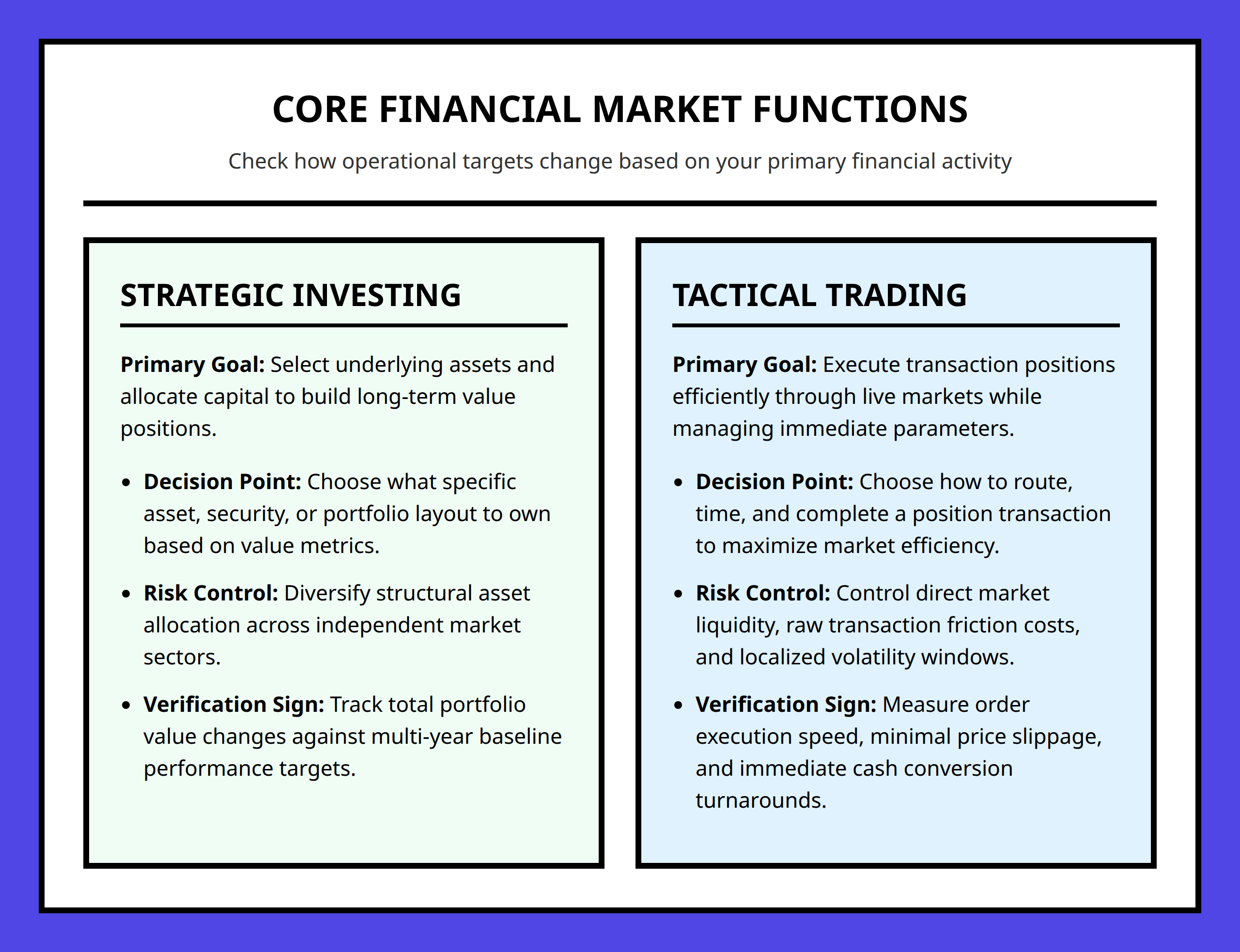
The simplest distinction is this: investing determines what position to take, while trading determines how that position is implemented.
An investment decision focuses on selecting a security, building a portfolio, or allocating capital toward a particular opportunity. The investor’s attention is directed toward ownership, valuation, expected returns, and long-term objectives.
A trading decision comes afterward. Once a decision has been made to buy, sell, hedge, or adjust a position, the next question becomes how to execute that decision. The trader must think about timing, execution costs, available markets, counterparties, liquidity, and risk.
Consider a simple illustrative scenario. An investor decides that a particular company deserves a place in a portfolio. The investment decision is complete. The trading decision now begins: how many shares should be purchased, through which market, at what time, and with what type of order?
Many people focus almost entirely on investment selection. Yet execution quality can have a meaningful impact on results, especially when positions are large or markets are less liquid.
The Main Participants in Financial Markets
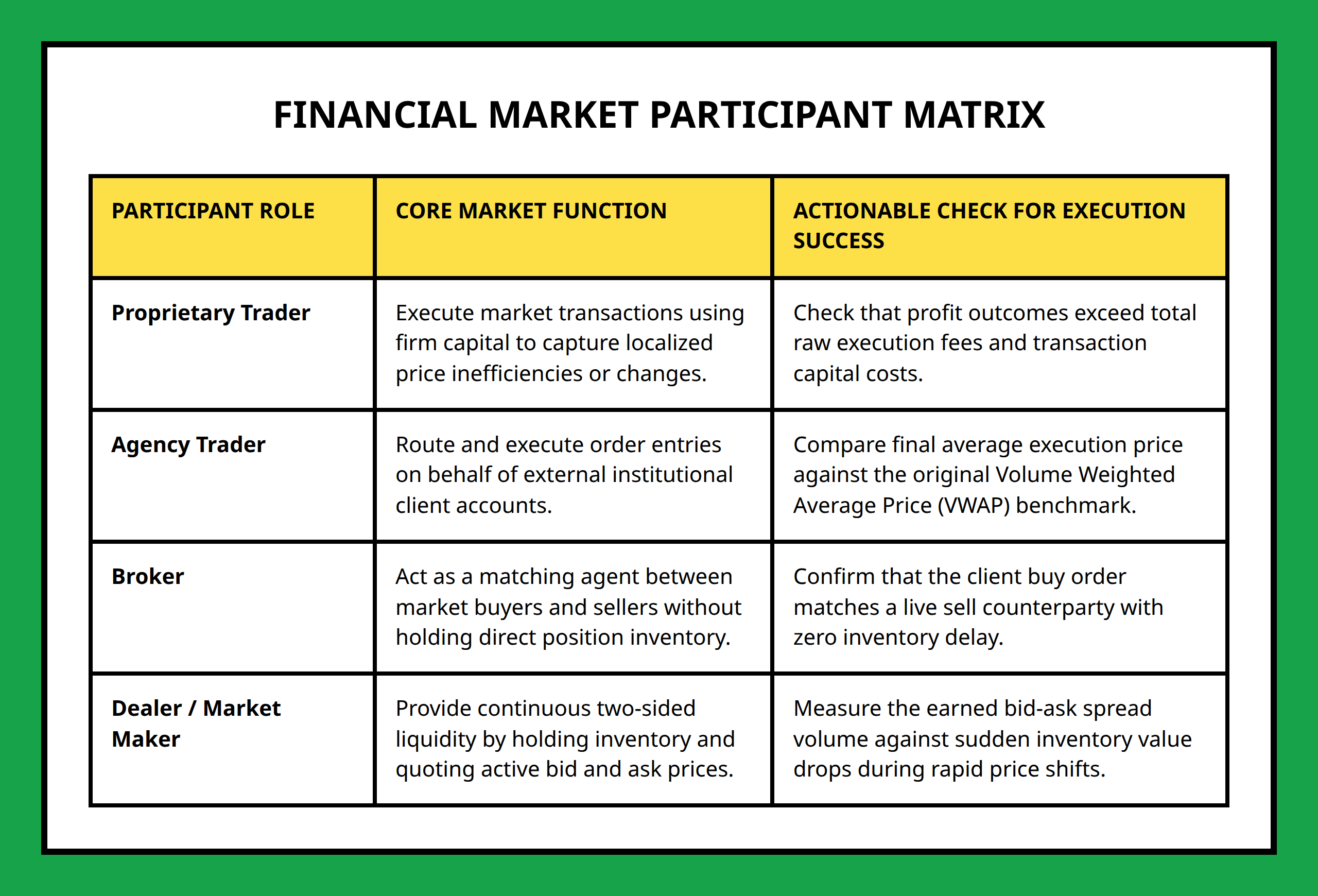
Financial markets contain many participants performing different roles. Understanding these roles makes it easier to understand how trading actually works.
| Participant | Primary Role |
|---|---|
| Proprietary Trader | Trades using the firm’s or individual’s own capital |
| Agency Trader | Executes trades on behalf of clients |
| Broker | Acts as an agent and helps locate counterparties |
| Dealer | Buys and sells directly while maintaining quotes |
| Buy-Side Participant | Seeks investment positions and purchases liquidity |
| Sell-Side Participant | Provides liquidity and trading services |
A useful distinction is the difference between the buy side and the sell side.
Many people assume these labels simply mean buyers and sellers of securities. That is not the case. Buy-side participants include institutions such as mutual funds, pension funds, and individual investors that seek investment positions. Sell-side participants provide market access, liquidity, and trading services.
In other words, buy-side participants are often purchasing liquidity, while sell-side participants frequently provide it.
Why Market Participants Trade
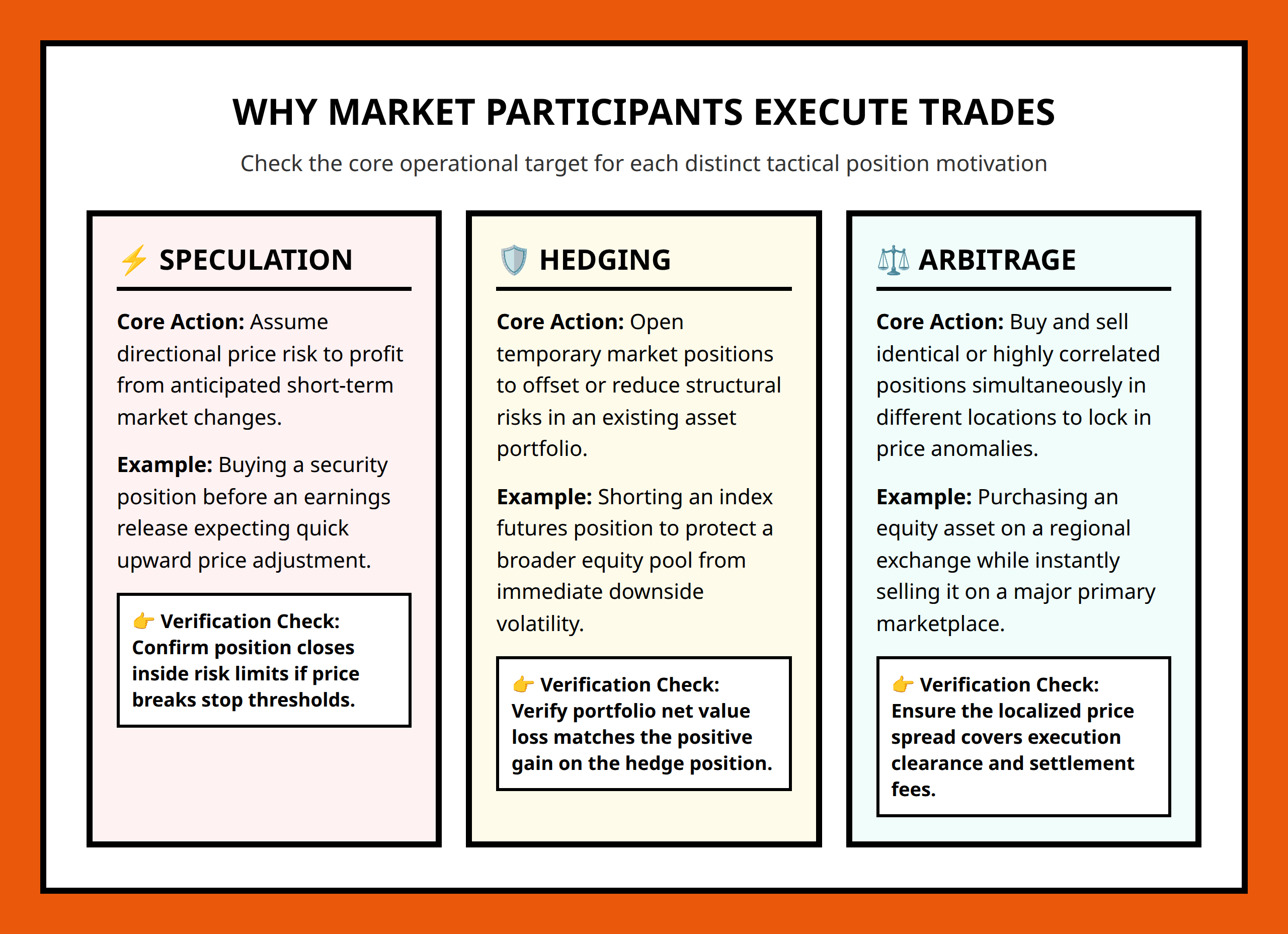
People trade for different reasons, but three motivations appear repeatedly across financial markets.
Speculation
Speculators seek profits from changes in prices. Their success depends heavily on their ability to forecast future market movements better than competing market participants.
In an illustrative example, a trader may believe a security is undervalued and purchase it expecting its price to rise. If the forecast proves correct, the trader earns a profit.
Arbitrage
Arbitrage involves exploiting price discrepancies.
An arbitrageur attempts to buy and sell substantially similar assets at different prices, capturing the difference. Success depends on speed, efficient execution, and low transaction costs.
Unlike speculation, arbitrage focuses less on predicting future prices and more on identifying current pricing inconsistencies.
Hedging
Not every trade exists to generate profit directly. Many trades are designed to control risk.
Hedgers use securities and other instruments to offset exposures that already exist elsewhere in a portfolio or business activity. The goal is not necessarily to maximize returns but to reduce uncertainty.
This distinction is important because it shows that trading is not always about aggressive profit-seeking. Sometimes it is primarily a risk-management activity.
Why Execution Matters More Than Many Investors Realize

A common mistake is assuming that once the investment decision is correct, the hard work is finished.
In reality, trade execution introduces its own challenges.
Markets differ in liquidity, transparency, and pricing. Large orders can move prices. Different counterparties may offer different execution quality. Delays can increase costs. Even the process of finding a suitable buyer or seller can affect outcomes.
Imagine two investors who make the same investment decision. One executes efficiently with minimal transaction costs and limited market impact. The other executes poorly and pays significantly more to establish the same position. The investment thesis may be identical, but the results can differ.
This is why modern markets devote significant attention to liquidity, order handling, execution quality, and market structure.
Common Misconceptions About Trading and Investing

Misconception #1: Trading and investing are completely separate activities.
They often overlap. High-turnover investment strategies can blur the distinction between the two. Many market participants engage in both investing and trading simultaneously.
Misconception #2: Trading is simply short-term investing.
Time horizon alone does not define trading. The central issue is execution. A long-term investor still relies on trading mechanisms when entering or exiting positions.
Misconception #3: Trading exists only for speculation.
As discussed earlier, many trades exist to hedge risk, provide liquidity, or exploit pricing relationships rather than to predict market direction.
Misconception #4: Good investments automatically produce good outcomes.
Poor execution, inadequate liquidity, or excessive transaction costs can weaken the benefits of an otherwise sound investment decision.
The more I study financial markets, the more I find that successful market participation requires understanding both sides of the equation: choosing the right opportunity and executing it effectively.
FAQ

Final Thought
The most useful way to think about financial trading vs investing is that they answer different questions. Investing answers, “What should I own?” Trading answers, “How should I get it, manage it, or exit it?”
If you want to understand financial markets more deeply, start paying attention not only to the securities being selected but also to the path those decisions take through the market. The next time you evaluate an opportunity, separate the investment decision from the trading decision and assess both on their own merits.
- Liquidity: The ease with which a security can be bought or sold without significantly affecting its price.
- Speculation: Trading based on expectations about future price movements.
- Arbitrage: Simultaneously buying and selling similar assets to profit from price differences.
- Hedging: Using financial positions to reduce or offset risk.
- Broker: An intermediary who helps clients execute trades.
- Dealer: A market participant who buys and sells directly while maintaining bid and offer prices.
- Buy Side: Investors and institutions seeking investment positions and liquidity.
- Sell Side: Market participants that provide liquidity, execution services, and market access.
