Strategic intangibles are non-financial strengths like brand power, management quality, and market leadership that drive long-term business success. They often explain why some companies outperform even when financial numbers look similar on the surface.
When people first learn investing, they usually focus on numbers—earnings, revenue, margins, or valuation ratios. These are important, but they don’t always explain why one business consistently beats another over many years.
Over time, a different layer becomes harder to ignore: the qualities that don’t show up clearly in financial statements. These include how strong a company’s brand is, how well management makes decisions, and whether the company has built a durable position in its market.
This is where strategic intangibles matter. They sit underneath the numbers and often determine whether those numbers stay strong or slowly weaken.
Takeaways
- Financial statements show results, but strategic intangibles explain why those results happen.
- Strong businesses often rely on hidden advantages like brand trust and management skill.
- Competitive advantage is not just market share—it includes long-term durability.
- Weak qualitative factors can slowly erode even strong financial performance.
- Good investing requires combining numbers with business quality judgment.
Why Numbers Alone Are Not Enough in Investing
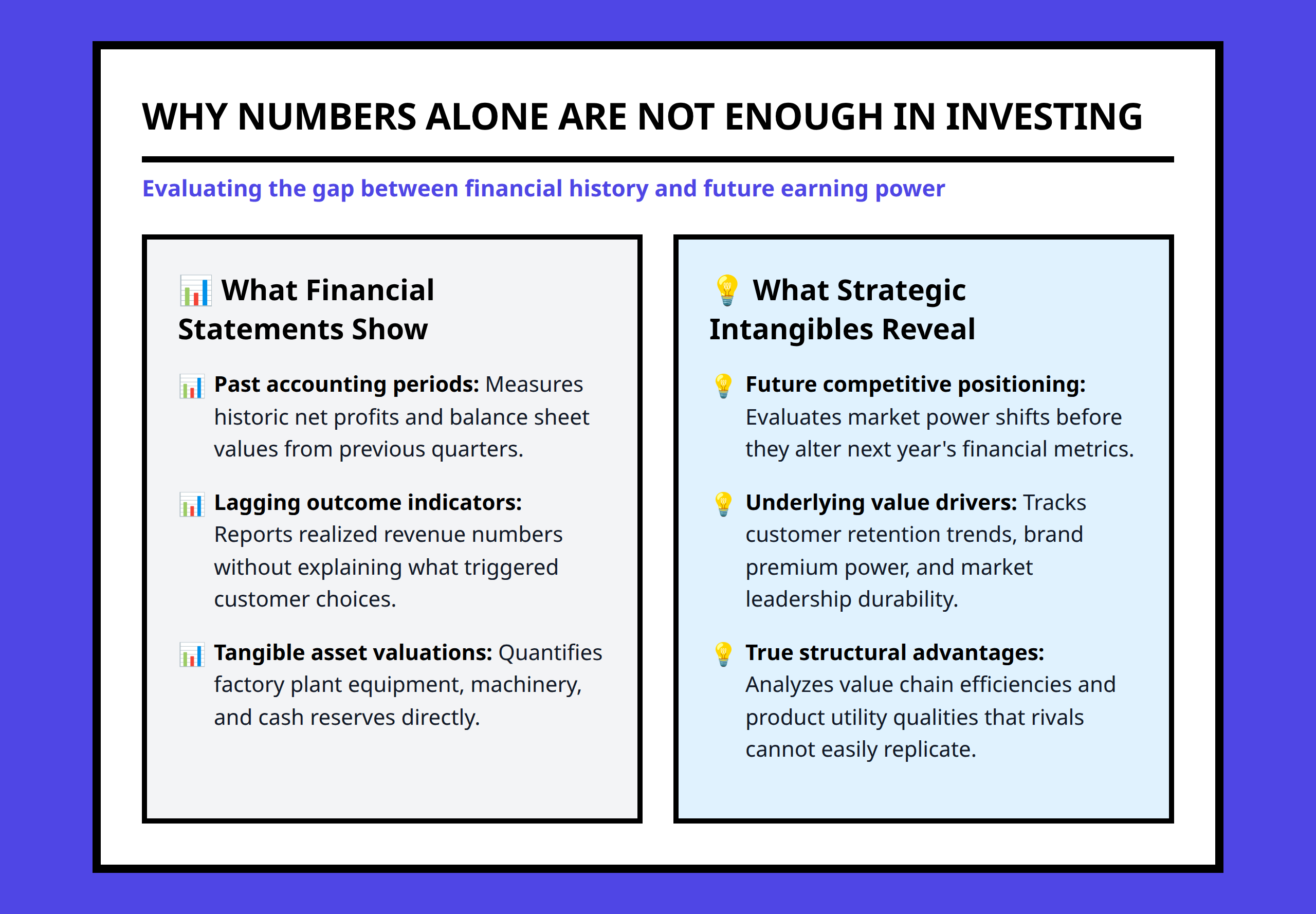
Financial analysis is essential, but it has a natural limitation: it mostly reflects what has already happened. Revenue, profit, and margins are backward-looking indicators. They tell you how a company performed in the past, not necessarily how it will perform in the future.
This creates a gap between financial performance and business reality. Two companies can show similar earnings today but have very different futures depending on their underlying strengths.
For example, one company might rely heavily on price competition, while another has strong customer loyalty that allows it to maintain pricing power. On paper, they may look similar in a given year, but their long-term stability is very different.
This is where qualitative evaluation becomes important. Strategic intangibles help explain whether current performance is likely to continue, improve, or decline over time.
In simple terms, financial numbers tell you “what happened,” while strategic intangibles help you understand “why it happened” and “whether it can continue.”
Key Types of Strategic Intangibles That Matter
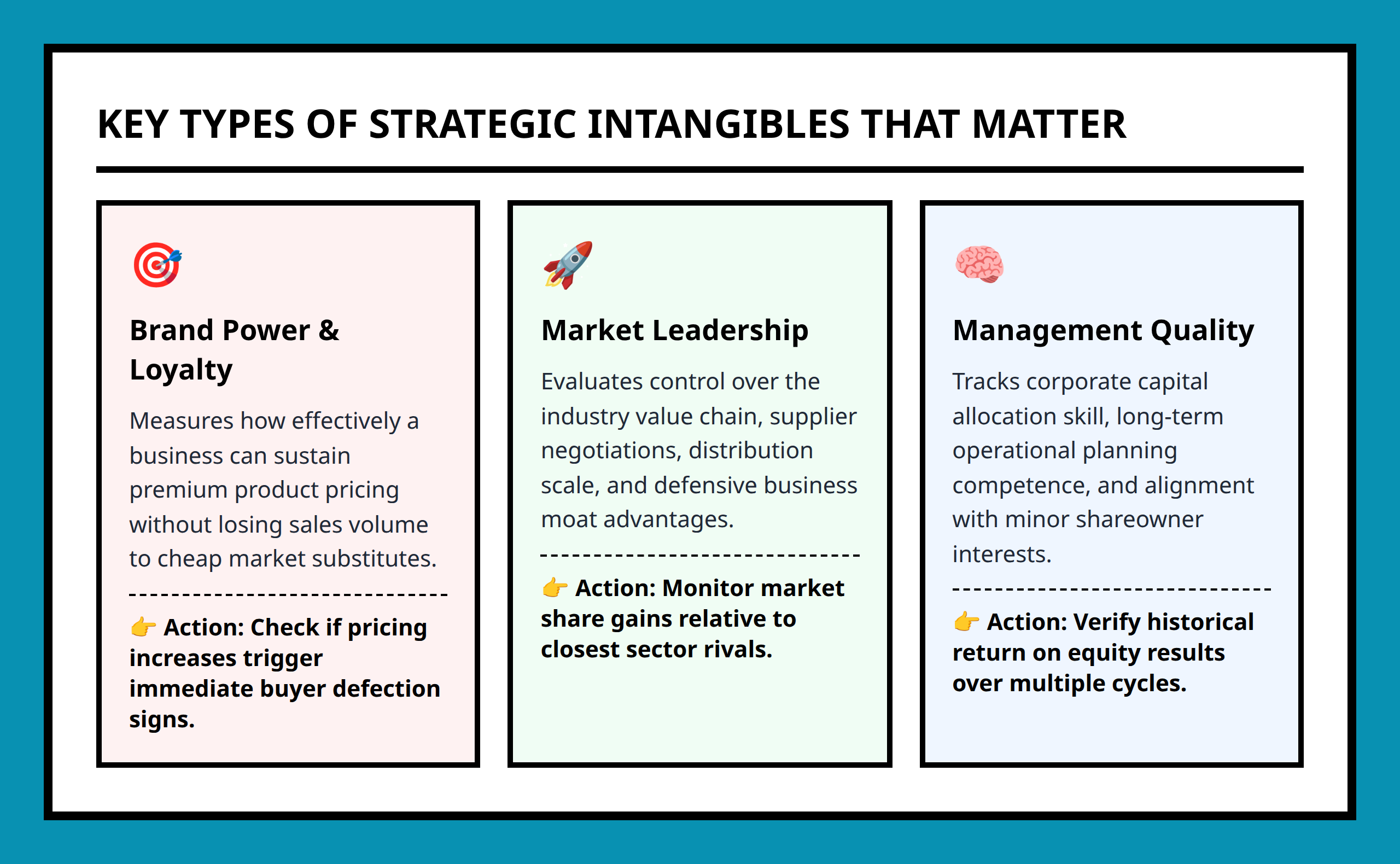
Strategic intangibles are not random soft factors. They usually fall into a few clear categories that directly influence long-term business success.
1. Brand Strength and Customer Loyalty
A strong brand does more than create recognition. It builds trust. When customers trust a brand, they are more likely to buy again, even if cheaper alternatives exist.
This loyalty reduces the cost of acquiring new customers and creates stability in revenue over time. Companies with strong brands often have more predictable business performance because their customer base is less sensitive to short-term changes.
2. Market Leadership and Competitive Positioning
Market leadership is not only about being the biggest player. It is about having a position that is difficult for competitors to challenge.
This can come from scale, distribution strength, technology advantages, or network effects. A strong competitive position allows a company to maintain pricing power and defend its market share even when competition increases.
3. Management Quality and Decision-Making
Management quality is one of the most difficult factors to measure, but it has a major impact on long-term outcomes.
Good management focuses on capital allocation, long-term planning, and disciplined decision-making. Poor management may deliver short-term growth but weaken the business over time through inefficient use of resources or inconsistent strategy.
Over years, these differences compound. Two similar companies can diverge significantly based on leadership quality alone.
How Strategic Advantages Influence Financial Performance
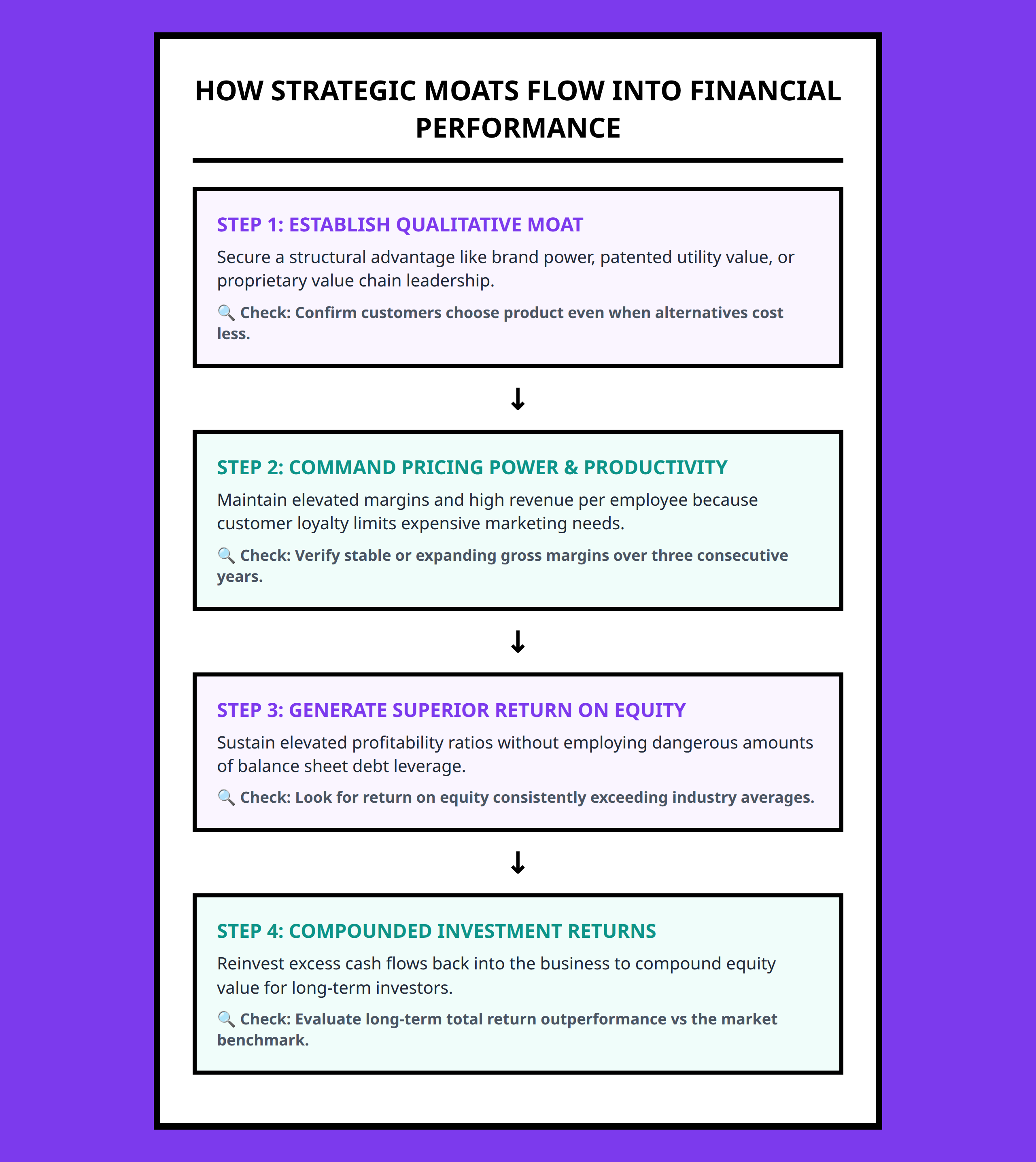
Strategic advantages do not replace financial results—they shape them.
When a company has strong intangible strengths, those strengths usually appear in its financial performance over time through higher margins, more stable earnings, and stronger returns on invested capital.
For example, a business with strong brand power may not need to spend as much on marketing to attract customers. That efficiency improves profitability.
Similarly, a company with strong market positioning can often maintain pricing power, meaning it can raise prices without losing customers. This directly impacts revenue growth and profitability.
Management quality also plays a role here. Efficient capital allocation can improve return on equity and help the business grow sustainably without unnecessary risk.
In this way, strategic intangibles act like invisible drivers behind financial results. They don’t appear as standalone line items, but they influence almost every financial metric investors care about.
Common Mistakes When Evaluating Business Quality
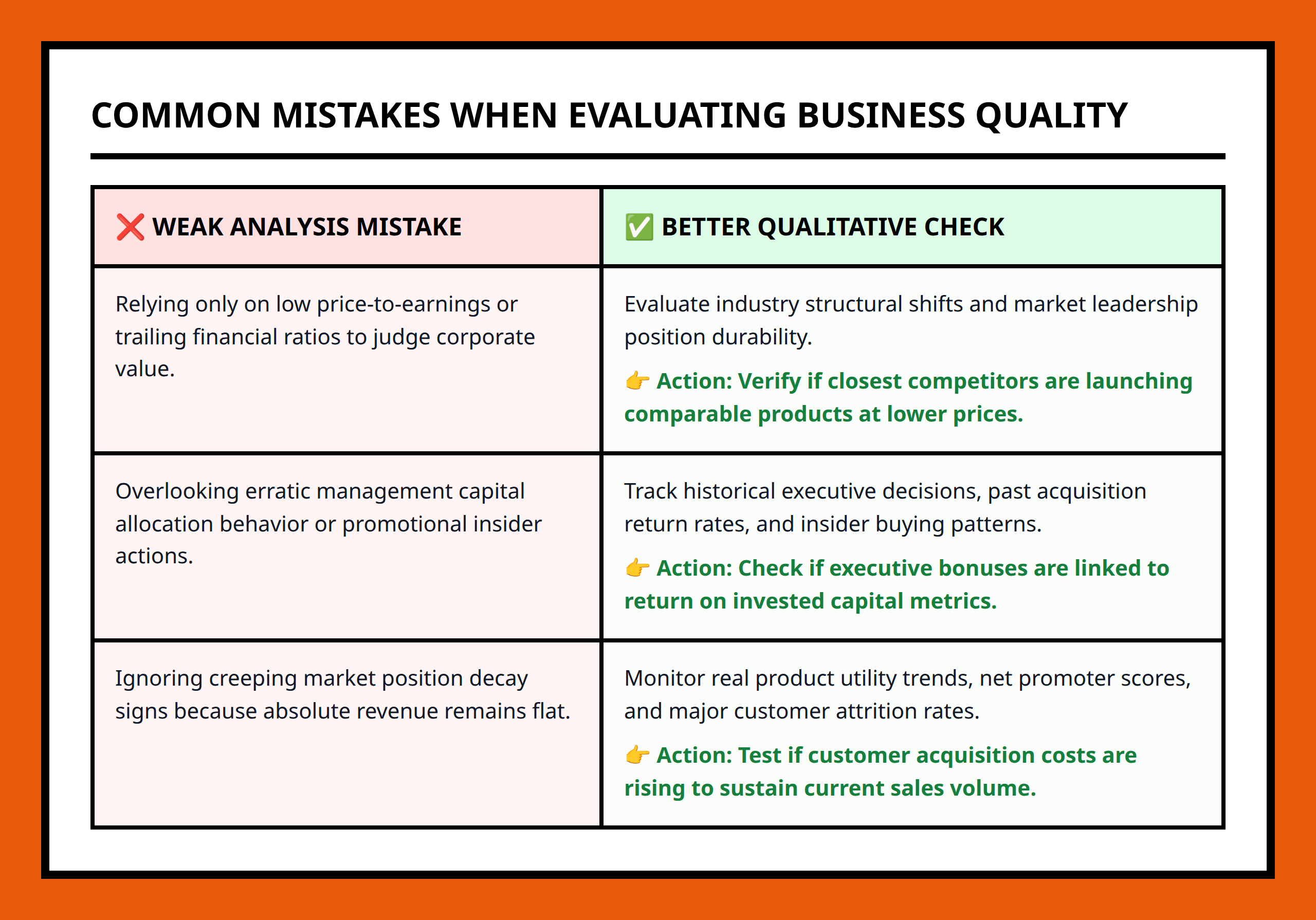
Many investors focus heavily on numbers and underestimate the importance of qualitative factors. This can lead to incomplete or misleading conclusions about a company’s true strength.
Overlooking Management Behavior
One common mistake is ignoring how management actually behaves over time. A company may report strong earnings, but if management consistently makes poor capital decisions, those earnings may not be sustainable.
Looking at decisions around reinvestment, debt, and acquisitions often reveals more than short-term financial results.
Ignoring Changes in Market Position
Another mistake is assuming a company’s competitive position is permanent. Markets evolve, and competitors adapt.
A company that appears strong today may gradually lose its advantage if it fails to innovate or respond to changing customer needs. Strategic position must be evaluated as a dynamic factor, not a fixed one.
Relying Only on Financial Ratios
Financial ratios are useful, but they can be misleading when used in isolation. A low valuation multiple does not guarantee a strong investment if the underlying business quality is weak.
Similarly, a high-quality business may appear expensive based on traditional ratios, but still deliver strong long-term returns due to its strategic advantages.
The key is understanding what the numbers are actually reflecting, not just comparing them mechanically.
Underestimating Competitive Erosion
Even strong companies can weaken over time if their competitive advantages fade.
This often happens gradually. A brand loses relevance, a competitor becomes more efficient, or customer expectations shift. These changes may not appear immediately in financial statements, but they eventually impact performance.
Connecting Strategy and Long-Term Investment Thinking
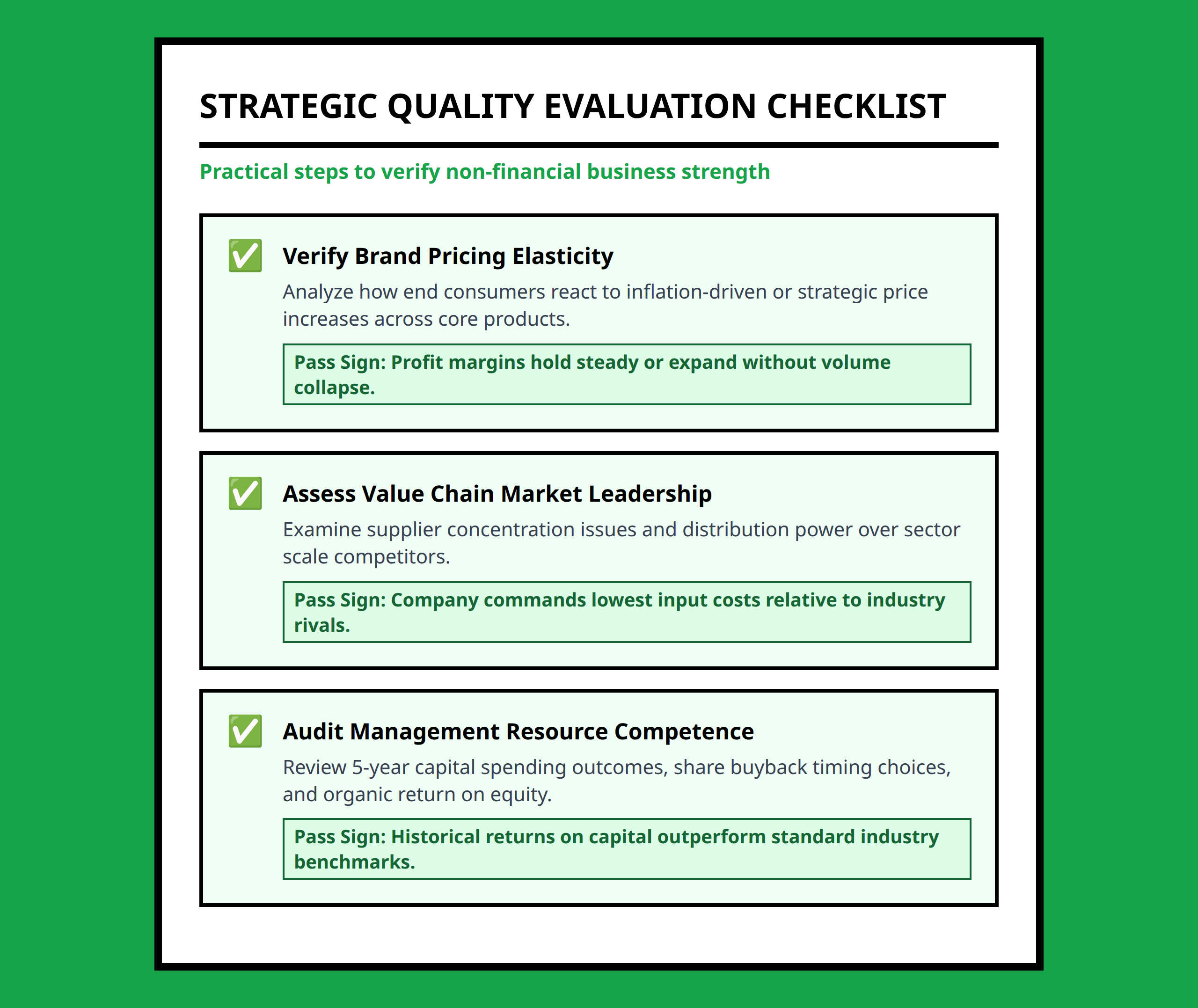
The real value of studying strategic intangibles is not to replace financial analysis, but to complete it.
Financial statements show where a business is today. Strategic analysis helps estimate where it is likely to go in the future.
When both perspectives are combined, investors gain a more realistic view of business quality. A strong balance sheet combined with strong strategic advantages often signals a more durable investment than financial strength alone.
This approach also helps avoid short-term thinking. Instead of reacting to quarterly results, investors can focus on whether the underlying business strengths are improving or weakening.
FAQ
- Strategic Intangibles: Non-financial strengths that influence long-term business performance, such as brand power and management quality.
- Competitive Advantage: A condition that allows a company to outperform competitors consistently over time.
- Brand Power: The ability of a brand to attract and retain customers based on trust and recognition.
- Return on Equity: A measure of how effectively a company uses shareholder capital to generate profit.
- Market Position: A company’s standing relative to competitors in its industry.
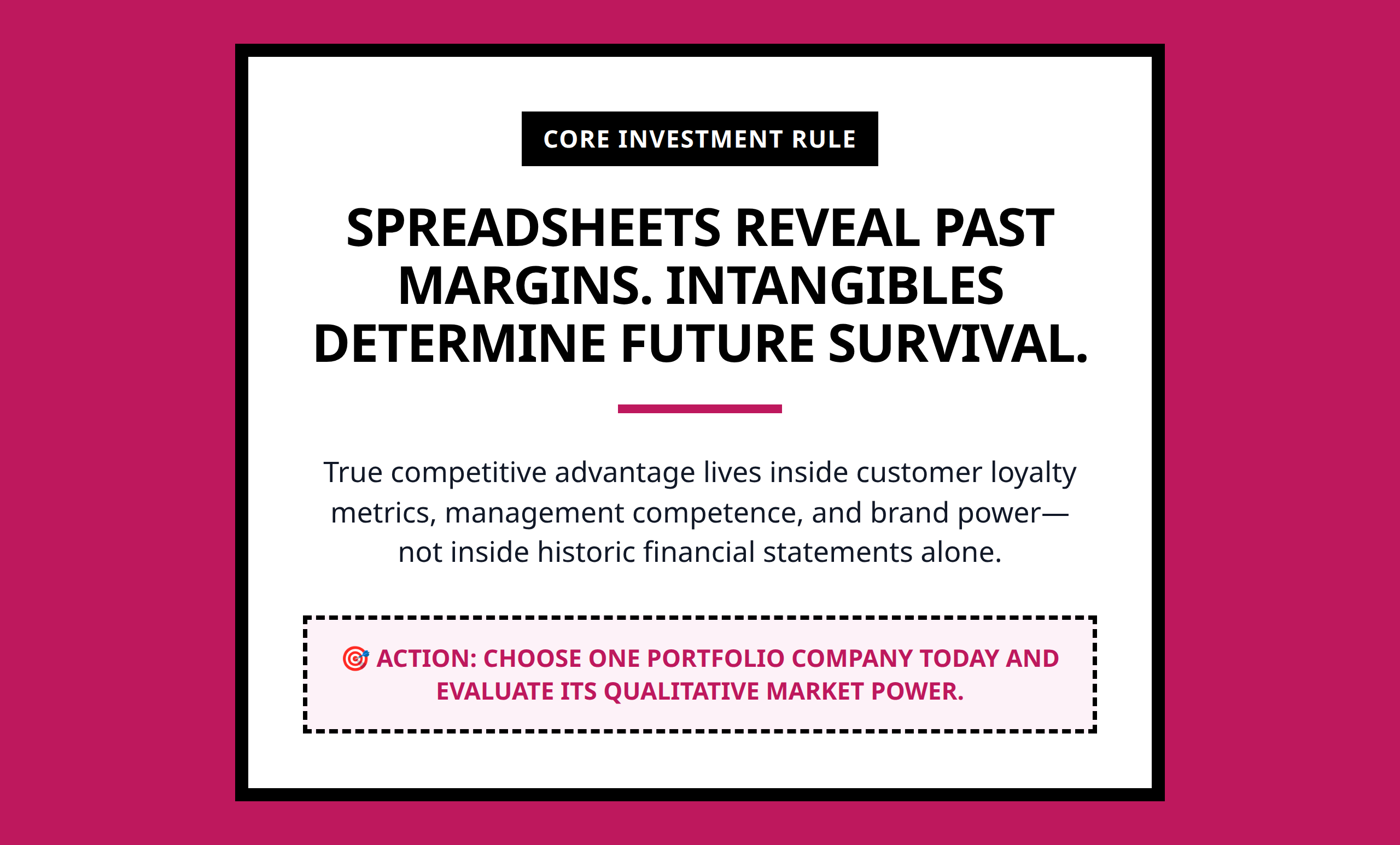
Strong investing decisions often come down to a simple distinction: numbers show performance, but strategic intangibles explain durability. A business that looks strong today is only truly attractive if its underlying advantages are strong enough to protect that performance over time.
A useful next step is to pick one company you already know and ask a simple question: what makes this business hard to replace? The answer usually reveals more than any single financial ratio.
References:
- https://www.vaneck.com/blogs/moat-investing/intangible-assets-source-of-moats/
- https://www.wipo.int/en/web/intangible-assets
- https://www.sciencedirect.com/science/article/pii/S2199853124001501
- https://www.forbes.com/councils/forbescoachescouncil/2025/04/23/intangible-assets-the-new-currency-of-business-success/
- https://www.businessthink.unsw.edu.au/articles/intangible-assets-business-value-creation
- https://www.kmco.com/insights/unlocking-hidden-value-the-strategic-importance-of-intangible-assets/
- https://virtusinterpress.org/IMG/pdf/cbsrv6i4art17.pdf
- https://www.mckinsey.com/~/media/mckinsey/businessfunctions/marketingandsales/ourinsights/gettingtangibleaboutintangiblesthefutureofgrowthandproductivity/getting-tangible-about-intangibles-the-future-of-growth-and-productivity.pdf
- https://onlinelibrary.wiley.com/doi/full/10.1111/eufm.12547
